

26 Nov Luxury Garden Room vs Traditional House Extension | The 2026 Dublin Comparison

Last Updated: 17 November 2026
We all know that families tend to outgrow houses. Kids get bigger, hobbies need a home, remote work needs a door you can close once the day is done. As a result, the house that felt spacious five years ago can now feel like everyone’s living on top of each other.
There are two realistic ways to fix that without moving: build a house extension, or add a garden room. The fact is that both will give you more space, but getting to the finished result is very different in terms of cost, disruption, and in how long you’re waiting to plan the build.
In 2026, a garden room in Dublin typically costs less per square metre than a house extension. For example, an extension in Dublin can cost between €3000-€5000 (and beyond) per sq m, bringing the cost for a basic, no frills 30sq m kitchen extension to €150,000, with many homeowners spending far in excess of this.
By contrast a garden room costs between €1,700-€1,900 per sq m before VAT. On average, our customers spend around €45,000-€65,000, with our prices ranging from €37,000-€75,000 including VAT, depending on the size and fittings requested.
A garden room also doesn’t require planning permission for most builds up to 30 sq m under the new July 2026 exemption rules, and can be built in 3 weeks, compared to several months for a house extension.
An extension can be an invasive process, whereas a garden room is significantly less hassle: there’s no need to move out while the work is being done, or live with holes in walls and months of mess.
Here’s a deeper dive into how the two compare in 2026, using current Irish construction pricing and the newly expanded planning exemptions.
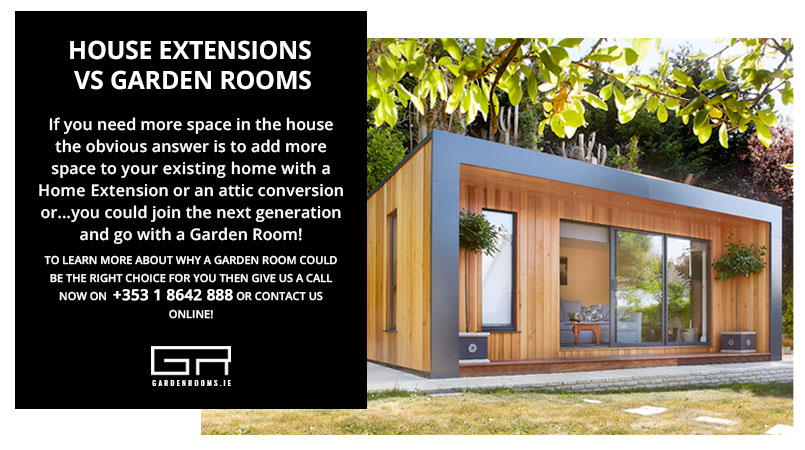
The Big Change for 2026: Planning Got Easier
If you looked into a garden room a few years ago and were put off by the old 25 sq m limit, it’s worth another look now. On 27 July 2026, new Exempted Development Regulations (S.I. No. 340 of 2026) came into force, giving homeowners significantly more freedom to build in their back garden without planning permission:
● Standard garden rooms, home offices, gyms and studios: the exempt floor area has increased from 25 sqm to 30 sqm.
● The standard house extension exemption also rose, from 40 sqm to 45 sqm.
The practical upshot for homeowners is that the majority of garden rooms, including home offices, gyms, studios, and playrooms, can still be built without ever entering the planning process. Plus, the size you can build without a planning application is now larger than ever.
Extensions, by contrast, will require full planning permission once you go beyond the allotted exemption of 45 sq m at the back of your home, if you build to the side, go up a story, plan to convert a garage or exceed the 45 sq m allowance, you will need to apply for planning permission.
There are also fees, drawings and a waiting period that come with applying for planning too. Because every site is different, elements such as boundary distances, existing structures or protected status can all affect eligibility.
1. Cost: Garden Room vs Extension in 2026
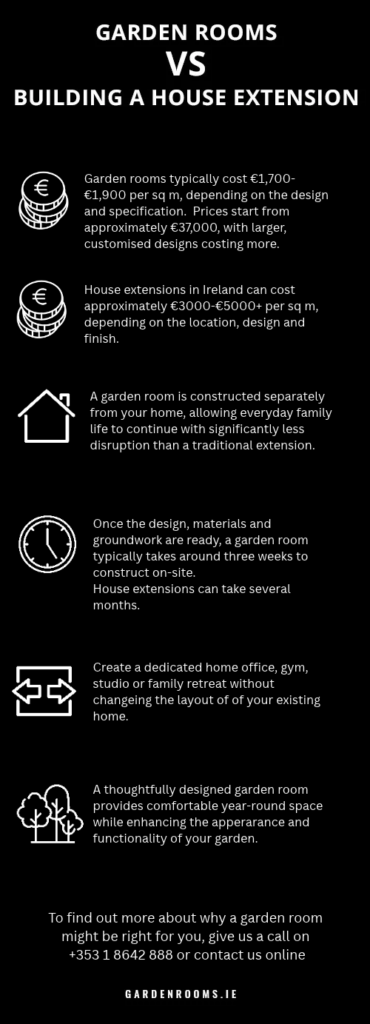 Construction costs have moved substantially upwards in the past few years, and here’s where things stand in 2026.
House Extensions in Ireland
Talk to friends or family who have done an extension over the past couple of years, and you will inevitably hear prices that run into hundreds of thousands of Euro. While conservative
estimates for house extensions costs range from €3,000–€5,000 and beyond per sq m, if you live in Dublin and the Greater Dublin Area, you can expect to pay even more.
You also need to consider labour demand, access, time of year and finishing specification into your final costs. As a result, a standard 30 sq m rear extension lands at approximately
€90,000–€150,000 once you include VAT, professional fees (structural engineer and BER assessment for example) and the inevitable extras that come with tying a new structure into an existing house.
You also need to factor in:
● Whether planning permission is necessary, as well as the fees and and the eight+ week statutory decision period (often longer if you have a request for further information)
● Party wall and boundary issues with neighbours
● The cost of living in a building site for months, or having to move out and rent elsewhere.
● The upgrades the existing house may need after a sustained period under construction: plastering, painting, new carpets or floor finishes, and new furniture.
Garden Rooms in Dublin and Surrounding Counties
A garden room typically costs a fraction of that per square metre, because there’s no need to break into an existing structure, match old foundations, or work around plumbing and wiring already in the walls.
Our garden rooms cost between €1,700-€1,900 per sq m before VAT, which means on average, our customers typically spend around €45,000-€65,000. In fact, our prices range from €37,000 to €75,000+ including VAT, depending on the size you go for, and the insulation spec and fit-out you choose.
As a result, a garden room is consistently the more cost-effective way to add a genuine, year-round usable room to your property.
We’ll always give you an exact, itemised quote based on your garden, your chosen design and your fit-out. Get in touch for current pricing, or read our price guide.
2. No Hassle, No Disruption
An extension means builders in your house, sometimes for months. In addition to the noise and mess, you’ll have dust sheets over the furniture, no kitchen for weeks, and the bathroom may be out of bounds at points too, if you’re upgrading an older property. Deliveries and skips will block your driveway, and all-in-all, your family routine will be turned upside down until the job is signed off.
One of the biggest benefits of a garden room is contained in the name: this is a selfcontained unit built away from your house, in the garden. Our crews work in their own space, keep the site clean and tidy, and don’t need to set foot inside your home. You get a brand new room without living through a renovation.
3. Speed: Weeks, Not Months
House extensions are notoriously hard to pin down on timeline. From planning delays, funding, and even the weather, you’ve also got to contend with finding a builder or general contractor, lining up all your trades, and factoring in the unpredictability of opening up an old building. It can all add up, and what was meant to take six weeks can easily run to six months.
Our garden rooms are built with 3 weeks on site, after the design and groundwork preparation is complete. You know your finish date in advance, and our crew works to it.
4. A Truly Separate Space
An extension usually means a bigger kitchen, living room or open-plan family space within your existing house. That’s exactly right for some families, but if what you actually need is separation, a garden room does some things an extension simply can’t.
● Working from home: Close the door to your office at 5:30pm and actually leave work behind. No commute required, but you get a real boundary between home and work life.
● Kids fighting over the TV or games console: Give them their own space, and get your sitting room back. This is especially valuable for those who have open plan spaces in their homes and who really need some separation as the family grows.
● Musicians, artists, or anyone with a noisy hobby: Practice, paint or play without disturbing the rest of the house.
● Teenagers who need privacy but not distance: They get their own space with friends over and you still know exactly where they are.
5. A Feature, Not Just a Function
A well-designed garden room doesn’t just add space, it adds to the garden itself. Rather than losing the garden to a large extension footprint, a garden room becomes a genuine feature: a warm, lit, cedar-clad building you’ll actually want to look at from the kitchen window.
Garden rooms are consistently cited by estate agents and surveyors as one of the more desirable additions a home can have, alongside the practical upside of extra square metreage.
Extension or Garden Room: A Quick Comparison
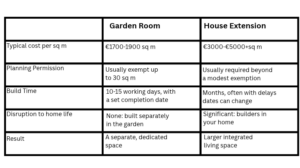
Extension or Garden Room: Which One Is Right for You?
If what you need is a genuinely separate space for work, home gym, hobbies, teenagers, guests or simply headspace, then a garden room gets you there faster, with less disruption, less planning risk, and typically a lower cost per square metre than an extension. If your goal is a bigger integrated kitchen or living area, an extension may still be the right call, and now, under the 2026 rules, both routes are easier to navigate than they’ve ever been.
Curious what’s possible in your garden? Visit our showroom to see the quality for yourself, browse our Cube, Ultimate and customised ranges, or get in touch for a current, no-obligation quote.
Frequently Asked Questions
Do I need planning permission for a garden room in Ireland in 2026?
In most cases, no. Since 27 July 2026, garden rooms, home offices, gyms and studios are exempt from planning permission up to 30 sq m (up from the previous 25 sq m limit), provided you meet the standard conditions: the structure sits to the rear of the house, height stays within 4m (pitched slate/tile roof) or 3m (other roof types), and at least 25 sq m of private garden space remains afterwards.
How much does a garden room cost compared to a house extension in Ireland?
House extensions in Ireland can cost between €3,000–€5,000 (and beyond) per sq m, with many extensions costing in excess of €150,000. Garden rooms are consistently priced lower per square metre, since there’s no need to break into an existing structure or tie into existing foundations. Get in touch for current, exact pricing based on your chosen design and fit-out.
How long does it take to build a garden room?
Not long at all. It will take around six weeks to order in your windows and doors, and once your design and groundwork preparation are finalised, we build garden rooms in 10–15 working days on site. House extensions typically take several months from planning submission to completion, and timelines are far less predictable due to planning delays, weather and trade scheduling.
Is a garden room a good investment?
Yes. A well-built garden room adds genuinely usable, year-round space to a property and is regularly cited by estate agents and surveyors as a desirable feature that supports resale value, particularly as a home office, gym or studio.
